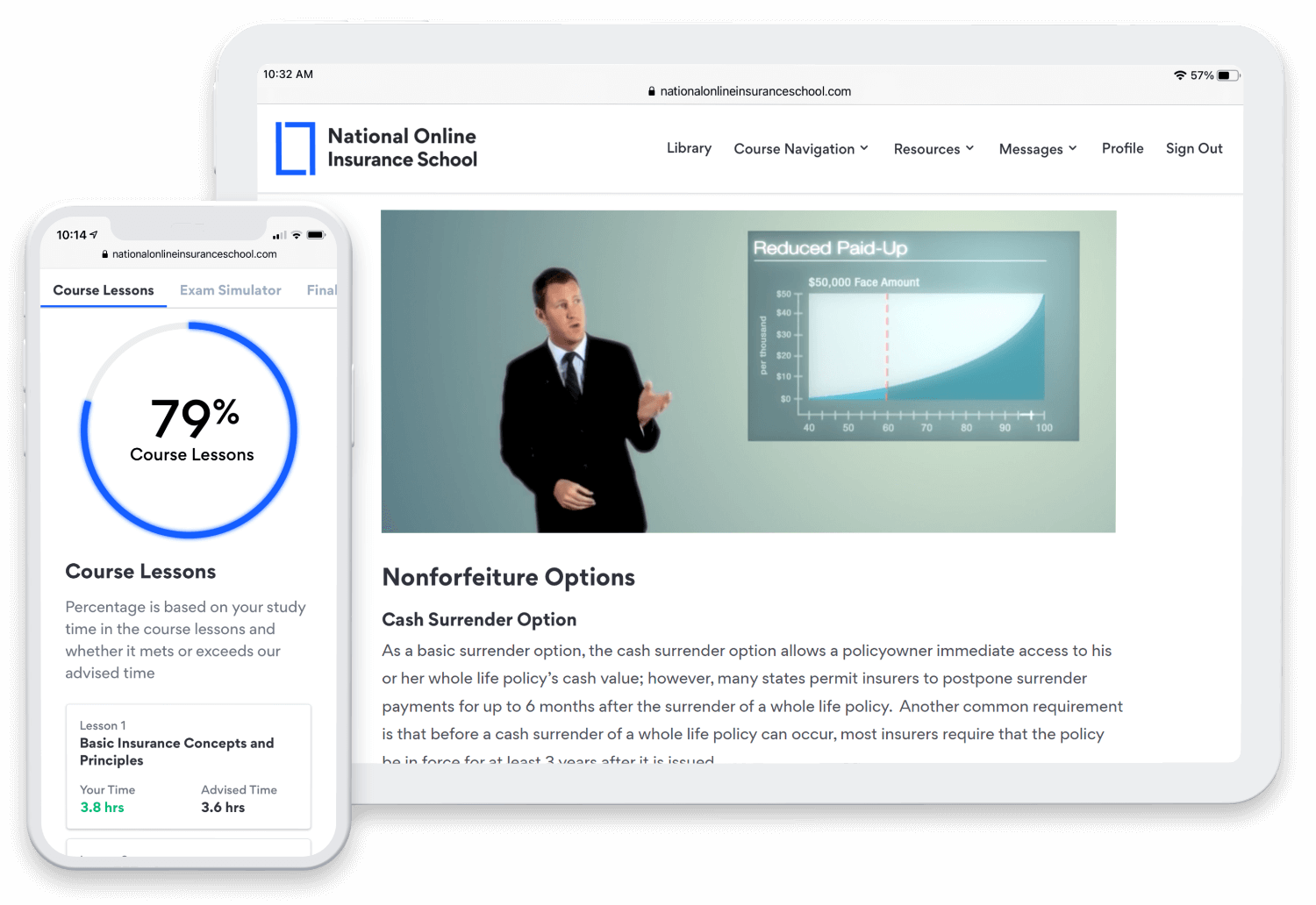
Choosing the best online insurance licensing course starts with two questions: does the course meet the requirements for the license you want, and will it actually prepare you to pass the state insurance exam?
Depending on the state, that may mean choosing an approved insurance pre-licensing course, an insurance exam prep course, or a program that combines both.
Those are not always the same thing. A course may satisfy a state’s required education hours while providing limited exam preparation. In states where pre-licensing education is not required, the value of an online insurance license course depends largely on how well it prepares you for the licensing exam.
Insurance licensing schools also differ in practice questions, exam simulations, course access, instructor support, performance feedback, guarantees, pricing, and whether important study tools are included or sold through different package levels.
This guide explains what to compare before choosing an online insurance licensing course and how to determine which course is the best fit for the state exam you plan to take.
View Our Insurance Licensing Courses to choose your state and the Life or Health license you want to pursue.
What Is the Best Online Insurance Licensing Course?
The best online insurance licensing course is one that matches your state and license type, satisfies required pre-licensing education when applicable, thoroughly prepares you for the state licensing exam, and gives you a reliable way to measure whether you are ready to test.
Depending on the state, that may be a required pre-licensing course, an exam prep course, or a program that combines both.
Look beyond the basic course description. Compare how the course teaches the exam content, how much realistic practice it provides, whether incorrect answers are explained, how performance is measured, how long you have access, what support is available, and what is actually included in the price.
Price matters, but it should be compared with what is actually included in the enrollment.
Insurance Pre-Licensing Course vs. Insurance Exam Prep
Pre-licensing education and insurance exam preparation are closely related, but they are not interchangeable terms.
A pre-licensing course satisfies an education requirement established by a state. When pre-licensing education is required, the state may specify the number of course hours, the required curriculum, provider requirements, and conditions for course completion.
Insurance exam prep is designed specifically to prepare a candidate for the licensing examination.
In states that require pre-licensing education, a strong course should do both. It should satisfy the state education requirement and prepare the student to pass the licensing exam.
Other states do not require formal pre-licensing education. In those states, an applicant may still choose an online insurance exam prep course because passing the licensing examination remains a major step in becoming licensed.
Understanding this distinction helps prevent one of the most common mistakes when comparing insurance courses: assuming every online course serves the same purpose in every state.
Start With Your State and Insurance License Type
Insurance licensing requirements are established at the state level.
The course you choose should therefore be built for the exact state and license you intend to pursue, whether that is Life, Health, Life and Health, or another line of authority.
Florida, Georgia, and New York require approved pre-licensing education for the primary Life and Health licenses covered by National Online Insurance School under their standard licensing paths.
Pennsylvania and Texas do not require state-mandated pre-licensing education for their standard Life and Health licensing paths. Candidates in those states can choose how they prepare for the state exam.
California eliminated its former product-specific pre-licensing requirement for Life and Accident and Health or Sickness applicants beginning January 1, 2026. California continues to require a 12-hour Ethics and California Insurance Code course before license issuance.
These differences are why a national statement such as “complete a pre-licensing course before taking the insurance exam” is not accurate for every state.
Before enrolling, review the Insurance License Requirements for your state so you know exactly which license and education requirements apply.
How to Compare Online Insurance Licensing Courses
Once you know the state and license you need, the comparison should shift from basic eligibility to exam preparation.
Several parts of an online insurance licensing course have a direct effect on the study experience.
Does the Course Cover the State Insurance Exam?
The course should be built around the concepts and state-specific material tested on the applicable licensing examination.
Life and Health licensing exams can include general insurance concepts, policy provisions, contract law, underwriting, Life insurance, annuities, Health insurance, disability coverage, and state insurance laws and regulations.
State-specific material matters. An online Life and Health course that explains only general insurance concepts is not enough preparation for an exam that also tests the laws and regulations of the state where you are becoming licensed.
Look for a course that integrates state material into the learning process rather than treating it as an afterthought.
How Many Practice Questions and Exams Are Included?
Practice questions are one of the most important parts of insurance exam preparation.
Reading a definition and recognizing it on a page is different from selecting the correct answer when several insurance terms or policy provisions look similar.
A useful practice system should allow you to move from shorter exams while learning into longer, timed exams as the state test approaches.
There is no required number of practice questions that automatically makes one course better. However, a larger question bank can expose you to more ways the same concepts are tested and make it less likely that improving scores are simply the result of remembering repeated questions.
Quality matters along with quantity. Look at whether the questions are realistic, whether incorrect answers are explained, whether full-length timed exams are available, and whether the system helps identify areas that need more study.
National Online Insurance School’s Insurance Exam Simulator contains more than 3,000 exam-style questions and allows students to create shorter customized exams or take timed practice exams that simulate the state testing experience.
Does the Course Explain Why an Answer Is Wrong?
A practice score tells you what happened. Useful feedback helps explain what to study next.
When you answer a question incorrectly, the course should reinforce the underlying insurance concept rather than simply display the correct answer.
As you take more practice exams, patterns in missed questions can also reveal specific subjects that need additional review. That makes practice testing useful for more than measuring a score.
National Online Insurance School provides detailed answer reviews and real-time feedback so students can identify areas that need additional review as they progress through exam preparation.
Can You Measure When You Are Ready for the State Exam?
An insurance exam prep course should give you something more useful than a feeling that you have studied enough.
Practice performance provides a measurable benchmark. National Online Insurance School recommends working toward an average score of at least 80% on 100-question timed practice exams before taking the state licensing exam.
One high score is less useful than consistent performance. Repeatedly performing well across different sets of questions provides stronger evidence of preparation than passing one familiar practice exam.
For more about what makes the licensing exam difficult and how preparation affects the outcome, review How Hard Is the Insurance License Exam?.
How Long Do You Have Access to the Course?
Course access matters because not every student follows the same study schedule.
Someone studying every day may be ready to test quickly. Someone balancing work and other responsibilities may need more time.
Check both the length of access and when that access begins.
National Online Insurance School provides 60 days of enrollment access beginning when the course is started. This allows a student to enroll without losing study time before they are ready to begin the course.
Also review the provider’s extension policy before enrolling. Knowing what happens if you need additional time is better than discovering the policy after the course expires.
Is Instructor Support Available?
Self-paced online study provides flexibility, but there will still be concepts that are easier to understand with help.
Before choosing an online insurance licensing school, determine whether course-content support is available or whether the provider primarily offers technical assistance.
The distinction matters.
A login problem requires technical support. A question about why a policy provision works a particular way requires someone who understands insurance.
National Online Insurance School provides access to licensed instructors seven days a week. Students can submit questions about course material and receive written responses they can refer back to while studying.
What Is Included in the Course Price?
Insurance licensing course prices are difficult to compare when providers package their study tools differently.
Some providers offer one course package. Others divide their products into several levels and add features as the price increases.
Before comparing prices, determine which package actually includes the tools you plan to use.
A lower advertised starting price is not necessarily less expensive if the exam simulator, additional practice questions, video instruction, instructor support, printed materials, or pass guarantee you want require an upgrade.
The better comparison is the total cost of the course configuration you would actually purchase.
All-Inclusive Insurance Courses vs. Tiered Packages
Neither an all-inclusive course nor a tiered package is automatically better. The important difference is understanding what is included at the price you are comparing.
Tiered packages provide flexibility for students who want basic study materials or prefer to pay more for additional tools and instructional formats. However, the lowest advertised package may not include all of the exam-preparation features you intend to use.
An all-inclusive course removes that decision by including the primary learning and exam-preparation tools within the same enrollment.
National Online Insurance School uses an all-inclusive structure for its Life and Health licensing courses. Students do not need to determine which package includes the Exam Simulator, real-time feedback, instructor support, or Guarantee Pass.
When comparing an all-inclusive course with tiered insurance exam prep packages, compare equivalent features and the total price you would actually pay, not simply the lowest advertised price.
Should You Choose an Insurance Course Based on Pass Rates?
Pass rates can be useful, but they need context.
Insurance schools may calculate and advertise pass rates differently. One number may represent everyone who purchased a course, while another may represent only students who completed specific preparation requirements.
That makes many provider-reported pass rates difficult to compare directly.
State-published results can be more useful when they are available because providers are being measured against the same licensing exam and reporting method.
Even then, consider the license type and number of exam attempts represented in the data. Life, Health, and combined exams can produce different results.
Pass rates are useful evidence, but they should not replace a broader evaluation of the course, practice system, support, access, and guarantee.
How Important Is a Pass Guarantee?
A pass guarantee can be valuable, but only if you understand what it guarantees.
Read the terms before enrolling.
Some programs require a particular practice-exam score. Others require a qualifying test to be completed within a specified period before the state exam. The benefit after an unsuccessful state exam can also differ between providers.
National Online Insurance School’s Guarantee Pass applies to qualifying pre-licensing and exam prep enrollments.
Students qualify by passing two consecutive Guarantee Pass exams within three business days before taking the state licensing exam. If an eligible student does not pass the state exam, Guarantee Pass provides a refund or free course extensions until the student passes.
Guarantee Pass does not apply to continuing education or California’s stand-alone 12-hour Ethics and California Insurance Code course.
A guarantee should be evaluated by both its qualification requirements and what the provider actually does if you do not pass.
What Should an Online Life and Health Insurance Course Include?
A strong online Life and Health insurance course should cover the Life and Health concepts and state-specific laws tested on the applicable licensing exam while providing a clear progression from learning the material to practicing it and measuring whether you are ready to test.
The practice system should provide enough question variety to apply those concepts repeatedly. Performance feedback should then show where additional review is needed before testing.
If the state requires pre-licensing education, the course must also satisfy that state’s education requirement.
This is especially important when comparing an online Life and Health course with a basic study guide or question bank. Practice questions can reinforce knowledge, but they are not a substitute for learning the underlying material.
Is the Cheapest Insurance Pre-Licensing Course the Best Value?
Not necessarily.
Price is important, particularly for someone entering a new career who may also need to pay examination, fingerprinting, and license application fees.
The lowest course price and the best value are not always the same. Compare what is actually included, including practice exams, performance feedback, instructor support, and any pass guarantee, rather than comparing advertised starting prices alone.
Also consider the total cost of becoming licensed. Course tuition is only one part of the process, and state exam, application, fingerprinting, and other licensing fees may also apply.
For a complete breakdown, review How Much Does It Cost to Get an Insurance License?.
How Long Should You Study for the Insurance Licensing Exam?
Exam preparation often takes about one to two weeks of focused study, although the total time can be longer when the state requires a specific number of pre-licensing education hours.
The amount of time you need also depends on the license type, prior insurance knowledge, study schedule, and how consistently you perform on practice exams.
Rather than choosing an exam date based solely on a fixed number of days, use practice performance to guide the decision. Early practice exams can identify subjects that need more attention, while later timed exams can show whether your scores are becoming both higher and more consistent.
Before the state exam, you should be able to complete a full timed practice exam without relying on familiarity with the same repeated questions.
For a deeper look at preparation time, review How Long Should You Study for the Insurance License Exam?.
What Makes National Online Insurance School Different?
National Online Insurance School has provided online insurance education since 2008 and focuses on Life and Health insurance licensing.
Courses are designed around the requirements of each state. Where pre-licensing education is required, the applicable course satisfies the required education while preparing students for the state exam. Where state-mandated pre-licensing education is not required, the course provides state-specific insurance exam preparation.
One enrollment includes the course and primary exam-preparation tools rather than separating them into multiple package levels.
Students receive 60 days of access beginning when the course is started, an Exam Simulator with more than 3,000 exam-style questions, unlimited practice exams, timed exam simulations, detailed answer reviews, real-time feedback, licensed instructor support seven days a week, and Guarantee Pass on qualifying enrollments.
Together, these features provide a path from learning the insurance concepts to practicing them, identifying weaker areas, and determining when you are prepared to take the state exam.
View our Insurance Licensing Courses by State to choose your state and compare the available Life and Health course options.
Questions to Ask Before Choosing an Insurance Licensing Course
Before enrolling, you should be able to answer these questions:
- Is the course for the correct state and license type, and does it satisfy required pre-licensing education when applicable?
- Does it cover the current state exam content?
- How much realistic practice testing is included, including full-length timed exams?
- Does the course explain incorrect answers and identify areas that need more study?
- How long does course access last, and when does it begin?
- Can you get help from someone who understands the insurance material?
- Are the study tools you want included in the advertised price?
- What are the qualification requirements and benefits of the pass guarantee?
Those questions reveal much more about an online insurance licensing course than a list of marketing features.
Frequently Asked Questions
What is the best online insurance pre-licensing course?
The best online insurance pre-licensing course is one that matches your state and license type, satisfies required education when applicable, and provides effective preparation for the state licensing exam. Compare course content, practice questions, exam simulations, performance feedback, access, support, pricing, and guarantee terms before enrolling.
What should I look for in an online insurance license course?
Look for state-specific content, realistic practice questions, full-length exam simulations, answer explanations, performance feedback, sufficient course access, instructor support, transparent pricing, and clear pass-guarantee terms. If your state requires pre-licensing education, confirm that the course also satisfies the applicable state requirement.
Is online insurance pre-licensing legitimate?
Yes. Online pre-licensing education is accepted in states that allow approved online education, provided the course and provider satisfy the state’s requirements. In states without mandatory pre-licensing education, online exam prep can be used to prepare for the applicable licensing exam.
Do I need an insurance pre-licensing course in every state?
No. Pre-licensing education requirements vary by state and license type. Some states require approved education, while others allow applicants to take the licensing exam without completing a state-mandated course.
What is the difference between insurance pre-licensing and exam prep?
Pre-licensing education satisfies a state education requirement when one applies. Insurance exam prep focuses on teaching and practicing the material tested on the licensing exam. In states with required pre-licensing education, a strong course should accomplish both.
What is the best Life and Health insurance exam prep?
The best Life and Health insurance exam prep should cover the applicable Life and Health concepts, state laws and regulations, and provide enough realistic practice to measure whether you are ready for the licensing exam. Question variety, timed exams, answer explanations, performance feedback, and instructor support are important factors to compare.
How many practice questions should an insurance licensing course include?
There is no required number. A larger question bank can provide greater variety and reduce memorization, but question quality, explanations, timed exam simulations, and performance feedback also matter. National Online Insurance School’s Exam Simulator includes more than 3,000 exam-style questions.
Are online insurance licensing courses self-paced?
Many online insurance licensing courses are self-paced, although some providers also offer scheduled webinars or live online classes. If flexibility is important, check whether the course is fully self-paced and whether lessons and practice exams can be completed according to your own schedule.
Should I choose an insurance licensing course based on price?
Price should be one part of the decision. Compare the total cost of obtaining the course, practice system, support, feedback, and other study tools you intend to use rather than comparing advertised starting prices alone.
Are practice exams important for the insurance licensing exam?
Yes. Practice exams help you apply insurance concepts in the multiple-choice format used on licensing exams, identify subjects that need more review, develop testing pace, and measure whether your scores are becoming consistently strong enough to schedule the state exam.
Does a pass guarantee mean I automatically receive a refund if I fail?
No. Pass guarantees have qualification requirements. These can include course completion, specified practice-exam results, testing within a certain period, or other conditions. Review both the eligibility requirements and the benefit provided before choosing a course based on a guarantee.
Choosing the Best Online Insurance Licensing Course
The best online insurance licensing course should give you a clear path from learning the material to preparing for the state licensing exam. If your state requires pre-licensing education, the course should also satisfy that requirement. In states without mandatory pre-licensing education, exam preparation becomes the primary reason to choose a licensing course.
Start with the requirements for your state and the exact license you want. Then compare how each course teaches the material, how much realistic exam practice it provides, whether it identifies areas that need more study, how long you can access it, what support is available, what is included in the price, and how its pass guarantee works.
National Online Insurance School combines state-specific Life and Health education or exam preparation with extensive practice testing, real-time feedback, licensed instructor support, 60-day course access beginning when the course is started, and Guarantee Pass on qualifying enrollments.
View Our Insurance Licensing Courses to choose your state and the Life or Health license you want to pursue.
Not sure which license or education requirement applies to you? Review our Insurance License Requirements before enrolling.