An insurance exam simulator is a practice system designed to help candidates apply what they have learned under conditions that more closely resemble a state insurance licensing exam.
It does more than provide individual practice questions. A useful simulator allows you to build exams from different subjects, combine topics, work under a time limit, review answers, and measure how consistently you can apply the material.
The purpose is not to reproduce the actual state exam or predict the exact questions you will receive. It is to give you a structured way to practice the concepts tested on the licensing exam and determine which subjects still need additional review.
What Is an Insurance Exam Simulator?
An insurance exam simulator is a practice system that organizes insurance licensing questions into structured exam sessions. Instead of answering isolated questions one at a time, you can practice selected subjects, combine multiple topics, take longer exams, and work under a time limit as the state exam approaches.
Depending on the system, an insurance exam simulator may allow you to select specific subjects, create shorter or longer exams, review correct and incorrect answers, track performance across topics, and identify areas that need additional study.
The purpose is to move beyond simply reading insurance concepts and begin applying them in an exam-style environment. This makes the simulator useful both for reinforcing what you have learned and for measuring how consistently you can apply the material across different types of questions.
How Is an Exam Simulator Different From a Practice Question Bank?
The terms “question bank” and “exam simulator” are not used exactly the same way by every insurance education provider, so the features matter more than the label.
A basic question bank generally gives you access to practice questions covering subjects such as Life insurance, annuities, Health insurance, policy provisions, and state laws. An exam simulator uses those questions to create a more structured testing experience, often allowing you to combine subjects, build longer exams, work under a time limit, and review performance after each attempt.
That distinction becomes more useful as the state exam approaches. Early in preparation, focused questions can reinforce individual subjects. Later, mixed-topic and timed exams can show whether you can move between different insurance concepts without knowing in advance what type of question will appear next.
What Does an Insurance Exam Simulator Measure?
An insurance exam simulator can help measure several parts of exam preparation that are difficult to judge simply by rereading course material.
Knowledge Across Different Subjects
A candidate may understand one part of the course well while struggling with another. Mixed-topic exams make those differences easier to identify because questions from Life insurance, annuities, policy provisions, Health insurance, and state regulations can appear within the same practice session.
If the same subjects continue producing missed questions, the results give you a practical reason to return to those areas before taking another full exam.
Performance Across Different Question Sets
One high practice score does not necessarily mean you are prepared for the licensing exam. Performance becomes more meaningful when you can maintain strong results across different combinations of questions.
A sufficiently large question bank also reduces the chance that improving scores are simply the result of remembering familiar questions. Consistent performance across changing question sets provides stronger evidence that you understand the concepts and can apply them.
For a deeper explanation, review Why Practice Exam Scores Alone Don’t Tell the Full Story.
Testing Pace
Timed practice exams can help you determine whether you are moving through questions at a sustainable pace. The goal is not to answer as quickly as possible, but to avoid spending so much time on individual questions that completing the full exam becomes difficult.
Practicing under a time limit also makes the testing process more familiar before exam day and gives you another performance signal beyond the final score.
Are Simulated Insurance Exams Helpful?
Yes. Simulated insurance exams can be an effective part of licensing exam preparation because they require you to retrieve and apply information rather than simply reread it.
They can help you:
- Reinforce insurance concepts
- Practice multiple-choice decision-making
- Identify weaker subjects
- Review mistakes
- Practice under timed conditions
- Measure whether performance is becoming more consistent
However, simulated exams should not replace learning the material. If you repeatedly miss questions on the same subject, taking more exams without reviewing that subject is unlikely to solve the underlying problem.
The better approach is to return to the course material, understand the concept, and then test yourself again with a different group of questions.
When Should You Start Using an Exam Simulator?
You do not need to wait until the end of the course to begin using an exam simulator. The type of practice you use should change as your preparation progresses.
While Learning the Material
Begin with shorter exams covering subjects you have already studied. At this stage, the purpose is reinforcement. Practice questions help show whether you can apply a concept after learning it and whether any material needs another review.
After Covering More of the Course
As you learn additional subjects, begin combining them within the same practice exam. Mixed-topic testing requires you to switch between insurance concepts rather than knowing in advance which subject each question will cover.
This makes the practice more demanding and provides a better measure of how well the material is coming together.
Before the State Exam
As the test approaches, progress toward longer, timed practice exams covering a broader range of material. At this stage, the goal is to confirm that performance remains strong across different subjects and question combinations under more realistic testing conditions.
For more guidance, review How to Know When You’re Ready for the Insurance License Exam.
Why Question Variety Matters
Question variety matters because repeated exposure to the same questions can make practice scores improve even when understanding has not improved at the same rate.
If you see the same question often enough, you may eventually remember the answer instead of applying the underlying insurance concept. A larger question bank reduces that problem by allowing concepts to appear in different questions, scenarios, and combinations.
Quantity alone does not determine the quality of an exam simulator. The questions should also be relevant to the applicable licensing exam, use plausible answer choices, provide useful answer review, and allow enough variation that performance reflects understanding rather than memorization.
Should Insurance Practice Exams Be Timed?
Timed practice becomes increasingly useful as the state licensing exam approaches, but not every practice session needs to be timed.
Shorter subject-specific exams are often most useful for reinforcing recently studied material and identifying concepts that need additional review. Longer practice exams serve a different purpose by helping you work through a broader range of questions within a defined amount of time.
Timed exams can help you practice maintaining a steady pace, moving between different subjects, handling difficult questions without becoming stuck, and completing a larger exam in one sitting. They also make the testing process more familiar before you sit for the actual licensing examination.
What Should You Do After a Practice Exam?
The review after a practice exam can be as valuable as the score itself. Instead of simply checking which questions you missed, determine why each incorrect answer occurred.
You may have misunderstood the concept, confused two similar insurance terms, overlooked an important word in the question, applied the correct rule incorrectly, or guessed because the material was unfamiliar.
Once you identify the reason, return to the underlying course material before taking another large exam. Over several attempts, look for patterns. If questions from the same subject continue causing problems, additional study of that subject is likely more useful than immediately taking another full practice exam.
What an Exam Simulator Cannot Tell You
An insurance exam simulator is a preparation tool, not a copy of the state licensing examination. It cannot predict the exact questions you will receive or guarantee that you will pass.
Exam content, structure, and requirements vary by state and license type. A simulator also does not replace approved pre-licensing education when a state requires candidates to complete that education as part of the licensing process.
Its value is in helping you apply what you have learned, identify weaker subjects, practice under testing conditions, and measure how consistently you are performing before the state exam.
How the National Online Insurance School Exam Simulator Works
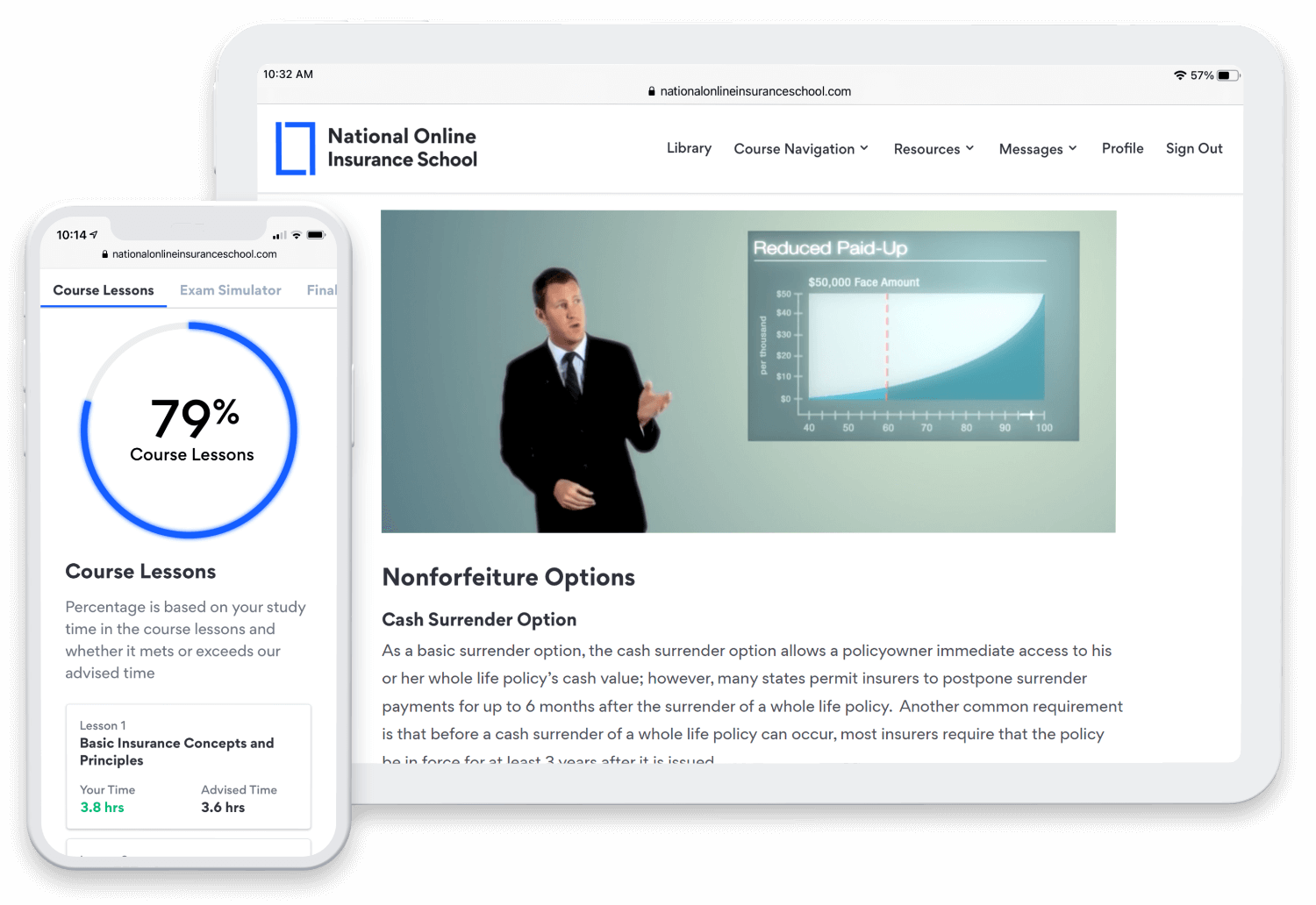
National Online Insurance School includes the Exam Simulator with its Life and Health insurance licensing courses. The simulator contains more than 3,000 exam-style questions and allows students to change the way they practice as their preparation progresses.
Students can begin with shorter customized exams based on selected course material and move toward longer timed exams as the licensing examination approaches. Each practice exam includes an answer review, while real-time feedback helps identify subjects that may need additional attention.
Practice exams are unlimited, allowing students to keep working through different question combinations rather than relying on a single practice test.
The overall process is:
Learn the material → practice it → review mistakes → focus on weaker subjects → test again.
How Many Practice Exams Should You Take?
There is no required number of practice exams that determines whether someone is ready for an insurance licensing exam. Taking more exams does not automatically produce better preparation.
What matters is what the results show. Practice should continue while you are identifying and correcting weaker subjects and until you can apply the material consistently across different topics and question sets.
That makes the quality and consistency of performance more useful than simply counting completed exams. Our separate guide, What Unlimited Practice Exams Really Mean, explains why unlimited access is most useful when each attempt provides meaningful practice rather than repeated exposure to familiar questions.
Frequently Asked Questions
What is an insurance exam simulator?
An insurance exam simulator is a practice system that organizes insurance licensing questions into exam-style sessions. It can help candidates practice multiple subjects, work under timed conditions, review answers, and identify areas that need additional study.
Is an insurance exam simulator the same as the real state exam?
No. An exam simulator is a preparation tool. It can recreate parts of the testing experience, such as multiple-choice questions, mixed subjects, and timed testing, but it does not contain or reproduce the actual state licensing examination.
Is an exam simulator better than practice questions?
They serve different purposes. Individual practice questions are useful for reinforcing specific subjects. An exam simulator combines questions into structured exams and becomes especially useful when you want to practice multiple subjects and timed testing.
When should I start taking simulated exams?
You can begin with shorter subject-specific exams while learning the material. As preparation progresses, move toward mixed-topic and longer timed exams.
Are timed insurance practice exams important?
Timed exams are especially useful before the state licensing exam because they help you practice pacing and complete a larger set of questions under testing conditions.
How many insurance practice exams should I take?
There is no required number. Continue practicing until performance is consistently strong across different subjects and question sets and weaker areas have been reviewed.
Can an exam simulator tell me when I am ready?
It can provide useful evidence about performance, consistency, weak subjects, and testing pace. Readiness should be based on multiple performance signals rather than one practice score.
Can I try an insurance exam simulator before enrolling?
Yes. National Online Insurance School provides free practice questions through its Exam Simulator so you can experience the question format and testing system before enrolling.
Use an Insurance Exam Simulator to Measure Progress
An insurance exam simulator is most useful when it becomes part of the study process rather than something you use only at the end.
Learn the material, reinforce it with focused practice, review mistakes, and then progress toward mixed-topic and timed exams. As your results become more consistent, use the simulator to identify any remaining weak areas and determine where additional review will have the greatest value.
The objective is not to memorize enough questions to produce a high practice score. It is to become comfortable applying insurance concepts across different questions, subjects, and testing conditions.
National Online Insurance School combines state-specific Life and Health education or exam preparation with more than 3,000 exam-style questions, unlimited practice exams, detailed answer reviews, real-time feedback, licensed instructor support, and Guarantee Pass on qualifying enrollments.
Ready to begin the complete course? Choose Your Insurance Course.